
We Don’t Have the Original New Testament Documents. Is This a Problem?
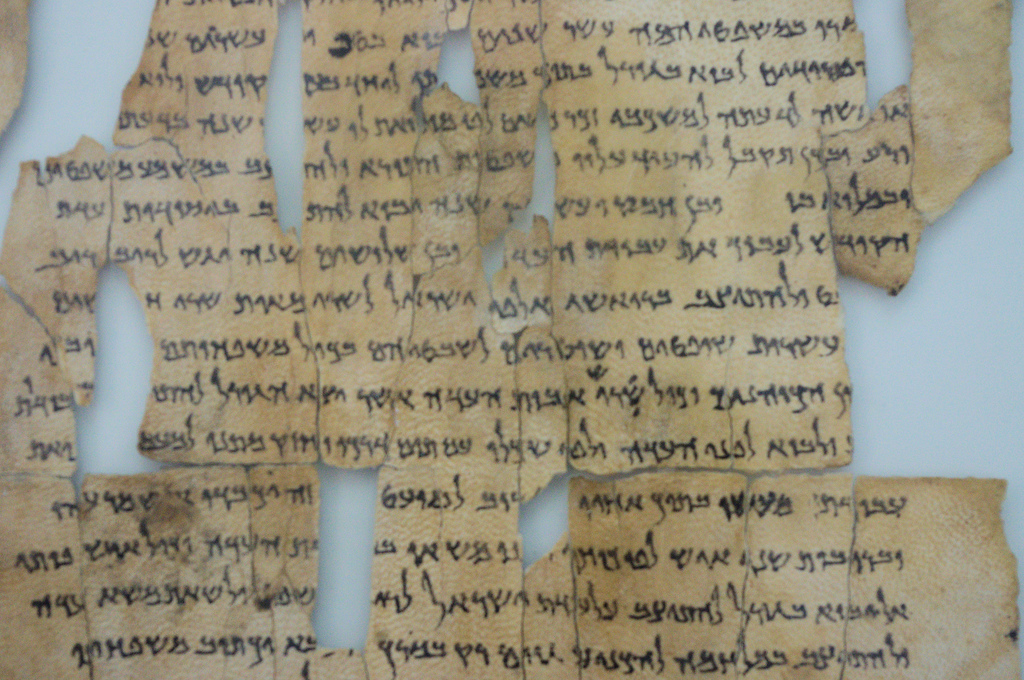
We don’t have the original New Testament documents. Is this a problem? In my early years of investigating the trustworthiness of the Bible I discovered that even though a lot of people at the popular level thought this was a problem, the scholars who worked in this field (called textual criticism) did not think it was a concern.
I discovered that the scholars recognized that even though we don’t have the original of any of the 27 individual letters or ancient historical biographies that make up the New Testament, that there were two factors that gave them confidence that the text we do have is substantially true to the original:
1. The number of early copies that we do have.
2. The short time gap between the original and the earliest copies we do have.
Since writing was done on perishable material at this time, copies had to be made in order to preserve the writings. Textual critics were well aware that there were some differences in the New Testament text among these copies – differences that were the result of both deliberate and accidental changes that early scribes made when copying these texts. But the vast majority of these differences were minor things akin to the way we have different ways of spelling some words in English.
Most importantly, given that we have thousands of New Testament copies from fragments to entire books, we are able to compare these copies with each other and ferret out the changes that were made. This then allows us to reconstruct the original.
I used to give the following illustration to show the effectiveness of this process:
Imagine that you are an English teacher and you write an original poem on the blackboard and ask you class of 100 students to memorize it. After 30 minutes you erase the poem and ask your students to write the poem down from memory word for word.
You ask a third party to analyze these 100 manuscripts and try to determine what the original text of the poem was. Let’s say that he finds the manuscripts to be exactly the same except for one word. Ninety-eight of the manuscripts have the word “and” in the fourth line and two manuscripts had the word “but”. With a strong degree of confidence he could reasonably conclude that the original most likely contained the word “and”.
This is similar to what we can do with the New Testament documents. Because of the number of early copies of the texts, we can reconstruct the text to around 99.8% accuracy. As for portions in questions, the differences are so minor that, for the most part, they do not affect any major Christian doctrine or historical event.
This was considered a “settled issue” and was the standard view among critics until the textual critic Bart Ehrman, a former fundamentalist, began publishing articles and books around 12-15 years ago claiming that we can’t be sure of what the original New Testament said. Ehrman’s argument is essentially that we don’t have copies of copies of copies of the originals. Our copies come hundreds of years later. Therefore, we can’t be sure of what the originals said.
According to Daniel Wallace, a frequent interlocutor with Ehrman, Ehrman’s position was not based on any new discoveries but only on what Wallace calls Ehrman’s “fundamentalist presuppositions” which he retained even after rejecting fundamentalist theology. Wallace thinks Ehrman’s views are an example of a “radical skepticism” that goes far beyond what the manuscripts tell us. “The evidence is otherwise,” according to Wallace.
In addition, Wallace calls attention to the fact that the average classical Greek writer has less than 20 copies of his works still in existence. “Stack them up,” he says, “and they’re 4 feet high.” With the New Testament there exists 5813 copies or fragments in the original language of Greek, a stack towering over the other classic Greek texts.
Moreover, if one considers copies in one language removed from Greek, then the number of New Testament manuscripts swells to over 24,000 that can be compared with each other. And these numbers are growing! I recently had the privilege of being part of a hands-on investigation in Dallas that extracted unidentified papyri that had not been seen by human eyes for close to 2000 years. Until the results are published in a year or so, I am not able to say much more about this, but I can say that some amazing Biblical discoveries were made!
Wallace and his team, who are dedicated to digitally preserving all the Greek copies and fragments of the New Testament still in existence, have in the last few years discovered 70 more Greek New Testament documents that have been “lost” in libraries and museums around the world. Wallace estimates thousands more left to be discovered and some of these are very early documents.
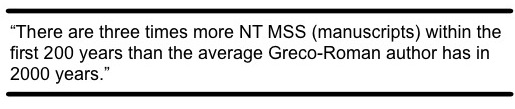
We have far more partial and complete copies of the New Testament which are they dated much closer to the original than the writings of Pliny the Elder, Plutarch, Josephus, Polybius, Pausanias, Herodotus, or Xenophon. The earliest existing manuscripts of these authors are 700 – 1,800 years removed from the original. According to Wallace, when it comes to the New Testament, “There are three times more NT MSS (manuscripts) within the first 200 years than the average Greco-Roman author has in 2000 years.”
Obviously, the shorter the time interval, the less opportunity for changes to have been made; and more importantly, the greater number of copies to compare with each other the easier it is to determine the original reading. The number of early manuscripts of the New Testament we have to compare with each other is far superior to any other ancient text by far. Ehrman’s radical skepticism does not seem justified given this almost embarrassing overabundance of early manuscripts.
If you would like to read more about this topic check out Daniel Wallace’s response to recent blog comments by Bart Ehrman.
Question: Do you think we are being presumptuous if we think God should have preserved His Word in a less messy fashion?
15 Responses to “We Don’t Have the Original New Testament Documents. Is This a Problem?”
Leave a Reply
Talk to Someone
Latest Tweets by @michaelhorner3
Archives
- 2013 (28)
- 2012 (28)
- November (2)
- October (2)
- September (1)
- August (1)
- July (3)
- June (4)
- May (5)
- April (4)
- March (5)
- February (1)
to STEVE FRANK- its in Matthew about the graves opening and the dead going into the city its not a mistake the gospels are written to different people like Matthew wrote to the Jews and the religious people of that day Mark wrote to the Romans and Luke to the Greeks and John wrote to everyone else. hope this helps– sharon
I forget which one, but one gospel(luke?) talks about the graves opening and the dead visiting. Yet all the other gospels make no mention of this in the passion stories. This would seem to be a big deal. Is this considered to be part of the 2% that dont match up? Because that never made sense to me, or is it an example of mid-rash.
good article thank you for the posting
PERSPECTIVE – Are The Gospels Reliable?
For the Lord is good; his mercy is everlasting. And his truth endureth to all generations.
*Psalm? ?100:5*
*Trust Jesus!*
Diana–
Thanks for your comments and the opportunity to help you understand more of where today’s Bible came from.
Unlike the telephone game, today’s modern translations of the Bible do not depend on what the previous translation had to say. Each of the new translations starts with the very best known Hebrew, Greek, and Aramaic parchments and scrolls, starting fresh without reference to previous translations. There are thousands upon thousands of partial and complete documents of the Old and New Testaments that are carefully weighed and authenticated. As new fragments and scrolls are discovered, they are carefully compared to others to verify their validity. There is every reason to believe that today’s modern translations (except for the Jehovah’s Witnesses New World Translation which was written only to concur with the Witnesses’ false teachings) accurately tell us what the original documents had to say.
I have to wonder, Diana, where your beliefs about God and Jesus came from if you couldn’t trust the Bible. In reality, the Bible is God’s revelation to mankind of all he wants us to know about him at this time.
While you are right that Jesus wants us to be loving and kind to others, that in itself is not enough to make one right with God and able to go to heaven when they die. And while the kingdom of God is very real, it does not reside within us. His kingdom is that which is being worked out in the world for all mankind. He has his purposes and plans, much of which is spelled out in the Bible.
I highly recommend you read the gospel of John, the 4th book in the New Testament. It describes in some detail how we are all sinners, that we are all under God’s wrath, and that we need to believe and trust in Jesus Christ alone in order to be forgiven. Please feel free to continue the conversation; ask any questions you may have.
did you ever play “telephone” as a kid?
all players sit in a circle, and the first person
whispers something in the person next to their ear.
that person repeats what the first person says to
the next person in the circle, and so on – until
the last person finally speaks out loud what she
has heard.
the result is usually nothing like what the first
person originally said.
this is how i see the bible’s evolution in to today’s
version, whichever one it is. translation upon translation…
line upon line… change upon change.
the only important thing is that i be “one with god”, that
“kingdom of god inside of us, just as
jesus wished it us be, and to be loving and kind to others
thankyou for reading this !
Hi James, thanks for joining in the conversation and adding your opinions. Can I ask for clarification of your position? Are you suggesting that the originals were inspired but with human intervention in the process of copying that we can no longer trust that the words contained in the New Testament are the inspire words from God? Or are you arguing the the originals were just as un-inspired as any of the copies?
All well & good; However; It still remains; We have no originals to go by; Al we have is copies; In some cases it is copies of copies of copies, etc…..; Non-inspired Humans were involved; Mistakes were made; Some accidental; Some intentional; Therefore, we have no idea what the originals may have said; You can do all your studies & testing you want; We do not know who may have written the originals; The gospels were originally written anonymously; Not given any authorship until the 4th century; Plus; Only with Human intervention & ideas do we have what the bible is today; Completely Human; Case closed !!!!!!
John 14:6
“Jesus *said to him, ‘I am the way, and the truth, and the life; no one comes to the Father but through Me.'”
John 17:17
“Sanctify them in the truth; Your word is truth.”
Jeremiah 29:13
“You will seek Me and find Me when you search for Me with all your heart.”
Thank you Kahu
Blessings
Hello Andrew,
I think you may have misunderstood the target audience of this article. He’s not writing to non-Christians who may not believe the Bible to be true, he’s writing to Christians who believe the Bible to be true, but understand that that belief applies to the original writings. Which we obviously don’t have, so that’s why Mr. Horner has explained the science of textual criticism and how there are thousands of fragments to work through very carefully, so that with confidence, we can say that the Bible we have today is 98.8% true to the original and therefore can be used as our standard for faith and practice.
I would not believe this argument if it was used to show that the Koran or the Mormon Bible are true. You have a great point in that regard. The argument in this essay about the closeness to the original is just to show that it’s extremely close. It’s not an argument about whether the originals are true. Whether you believe that the originals are true, that is a matter of faith, though there are several rational arguments for the Bible’s veracity too. Take care.
1. The number of early copies that we do have.
2. The short time gap between the original and the earliest copies we do have.
—–
1. I don’t know where this idea came from. The number of copies of a manuscript have nothing to do with whether its contents are historically accurate. We have thousands of manuscripts of the Koran but I trust you don’t use that data in defense of the accuracy of the Koran.
2. So what? The Mormon Bible was composed just nine years after Joseph Smith’s “First Vision.” Once again, I trust you won’t be using the “short time gap = accuracy” argument for Mormonism, which means this is just more special pleading for Christianity.
Hi Kahu, I am impressed that you have immersed yourself in the detailed study of the manuscripts and fragments that we have available to us today through archeology. You are correct that the languages used in the texts of the Bible (Hebrew for most of the Old Testament, Greek for most of the New Testament and some Aramaic in places in both) have changed over time. People speaking modern Greek would have trouble reading Koine Greek (the common language of the New Testament) just like a lot of people who speak modern English have a hard time reading Victorian English like Shakespeare.
Fortunately, we have a lot of written material in Koine Greek (this was the “language of the market place” in the 1st Century) and through comparative language study have been able to ‘re-create’ the language accurately so that translation work can be done with a high level of accuracy.
You are also correct about the differences that exist in the copies that were made of the original manuscripts of the Bible. We don’t have any of the original manuscripts but we do have a huge volume of copies that were made. There is a special study called Textual Criticism that looks at these documents and compares them in order to determine which one would be closest to the original. Some of the criteria for that study are how many years past is the copy from the original. In many cases the closer the time period the more accurate the copy. There is a fragment of the Gospel of John that was copied around 50 years after John originally wrote out his account of the life of Jesus. That is unprecedented for literature from that time period.
Other criteria for assessing the accuracy of a copy is the idea that a scribe was more likely to change something in the text to make it more easily understood rather than more complicated. Textual Critics also look for common transposing errors. With all the evidence that we have and all the work that has been done in the field of Textual Criticism most scholars are extremely confident that the words we have in our Greek New Testament are almost exactly (99%) the original words penned by the original authors in the first Century.
If you are interested in knowing more about Textual Criticism of the Bible Paul Wegner has a book out called “A Student’s Guide to Textual Criticism of the Bible: Its History, Methods and Results” which will give you a good start in this field.
Very helpful and well written article! Thanks.
All this might be ok with some and its a known fact that we should study to show ourselves approved. My research in finding the truth is still in progress. Although I do study The Bible as we know it, I also study that paticuliar time in history through artifacts that are available in museums, or articles of first findings. Some of my concerns have been answered, However, the answers given bring more questions.I am more of a hands on learner, we can talk about the validaty of the Bible. In mine findings the language written on the scripts are not spoken in these days, and translation would be dificult even for those who speak modern day Language. I also found that some of the scripts were written in more than one language, when translated some were similar some wasn’t depending on the author. Who is to say which script was the right one to choose for our Bible of today. It is also discovered there are more scripts found that are being translated today which are not yet included in our bible. Besides all those small errors and mistranslations, or rewrites who has the autority to tell me what is right about the Bible. I do believe in creation, I do believe in the fact that there is something more powerful and greater than us. This is why I pray for understanding, for wisdom to know the truth. My search continues. I really don’t want to be mislead by what man say, there is only one voice I want to hear and only then I will listen and understand.